
THE MODERN MINT BLOG
Topiary design is something I think about a lot. Well I would, what with being a topiary artist who makes and maintains topiary, hedges and shrubs throughout the year.
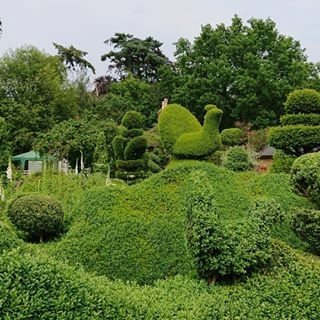
Topiary Design
I am still searching for a way to share with you why I prune certain plants a certain way. The easiest answer for me to give is –
“because pruning it that way is what it needs. That is just what the plant told me to do.”
But let’s face it, that is of no use to you.
Firstly because it gives you nothing specific or tangible to start designing your topiary from, secondly because I sound like a wally (you are saying the plant talks to you? what!?!?) and no-one listens properly to an idiot.
If you are uncomfortable with pruning and shaping, unsure about what you want to make, not quite clear in your understanding of how the plants grow or what they can become… then pruning becomes a pain point and something to panic about.
When really, pruning is fun!
Fun… and in some cases completely insane.
So I hope below I can share with you, gently, a few ideas to think about that might be useful to you in your garden.
Certainly when in your garden with a pair of shears in your hand!

When I Think About Topiary Design, I Think About…
Topiary design works on three levels for me.
The first thing you should master is the basics – learning to clip balls and cones.
Why these two shapes? Because they are the easiest to do by eye, needing time and patience to make them look well-clipped and sharp rather than any great skill. These shapes are also a template for more difficult and interesting shapes, as cones can become spirals and balls can become ‘nubbons’ or ‘twmps’.
Level two of topiary design, in my eyes, is less about the practical clipping of shapes and more about how they are used in the garden.
Context.
Does the piece of topiary act as a way marker, through to a new space?
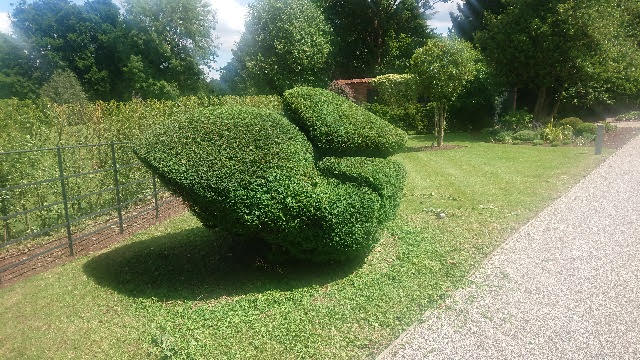
Is the topiary tall and slim, drawing the eye to the sky?
Will it reflect the sunlight? Our weak British sunlight is no match for the power of a Mediterranean sunbeam, but its softness can be harnessed to light a leaf, or shimmer through a well-thinned plant. Take note of where light hits in your garden, where it doesn’t, and see how you can use it to greater affect.
Does it seem in scale to the rest of the garden?
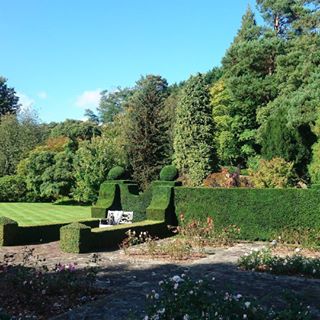
Too big and the effect is overpowering, a weighty, lifeless block of green that has no connection to the rest of the garden. Too small and it is lost, a pointless accessory.
The plants in your garden are an orchestra, you are the composer. You must know the ‘tinta’ of each plant the way a great composer will understand the colour and form that each instrument at her disposal can give to the music.
Once this is embedded in your psyche, your job is to add them to your garden so they work together. Three dark evergreen yew blobs will benefit from being placed near a mushroom of warm, deciduous beech leaf.
Contrast is how to design with topiary.
Contrast that is always in context to what is around it.
So What Is The Final Level of Topiary Design You Are Banging On About?
The last level is the hardest, yet the simplest.
It is designing topiary based on your sense of humour.
That’s it.
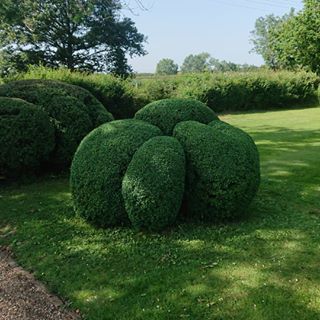
It is about completely and absolutely being yourself when you clip, catching a flow and a desire that shares you at your best, your most fun, you with your lightest touch…. all translated through your arms, your hands and into your shears…
It is about you making something that, when you step back, can only have been made by you, the plant you chose to prune, and in that moment.
I do realise it has all gone a bit spiritual here. Or just plain daft.
Stick to your balls and cones. That is the best way to start your topiary design work.
Then think about the questions I asked in stage two of topiary design. See what answers you can come up with in your garden.
Then… take a look at step three. The development and use of your instinct, your sense of humour, your own personality.
Allow this thought to percolate around in your subconscious.
Because who knows – it may make sense in a way you can’t understand, and leave you making some beautiful topiary designs you never thought possible.
Good luck!
See A Few Of My Topiary Design Projects Here
Modern Topiary, the Book, at Garden Media Guild
My book about topiary, Modern Topiary, has been mentioned on the Garden Media Guild newsletter…. As the screenshot says, the book can be read for free online here. At the bottom of the screenshot, it looks like another Garden Media Guild member has a book out called ‘A Year In A Cottage Garden’…. so if that is where your garden heart lies, check that out too! And at the top of the screenshot, it looks like I was listening to Pelleas et Melisande, by Debussy. What a classy chap I am, listening to classical music as I reply to emails. …
Start of the Whitby Topiary Library
I have been offered a space here in the centre of Whitby, south-facing aspect, with some raised beds in, so that I can make a Topiary Library. In my head, a topiary library is a place to showcase the common (and then not so common) shapes you can make out of topiary. With classical topiary plants, as well as some more unusual pieces. This Topiary Library can act as a reference for people to learn more about pruning and clipping. The space is small but the aspect is great and the beds are deep enough to put some plants in. …
Delivery After Dark – From the Makers of The Amelia Project
Last week I spent most nights stood in cold water streams on the moors of North Yorkshire, helping to film a new project called Delivery After Dark from the makers of the Amelia Project. I worked on the Amelia Project back at the end of 2024, lending my terrible vocal talents to a small part in the episode Didius Julianus. But this project is something new – and exciting! – and thankfully only needed me to be filmed, rather than to actually say anything. But not only did I have to stand in cold moving water at midnight, I also …