
THE MODERN MINT BLOG
Robinia is often forgotten – by me, actually! – when thinking of plants for topiary.
But when I work on it I do love it, brittle and soft as the wood is if you climb into it. But that danger of snapping a branch with a heavy step and falling out of the tree aside, I love it for the dappled light it allows into the garden space.
Robinia Near The Sea
Below is a Robinia I have gently clipped over the last few years, down near Leigh-on-Sea in Essex. The tree was large when I arrived, although it is in scale with the garden, but the client needed it thinned, the branches edited down, to keep the garden private from the neighbours yet allow the warmth of the sunshine to hit the patio.
My favourite kind of job, where you can prune a plant but make it look barely pruned, natural.. and this is where Robinia is such a strong choice, because it has a natural character of openness, of branching wide and layering stem upon stem.
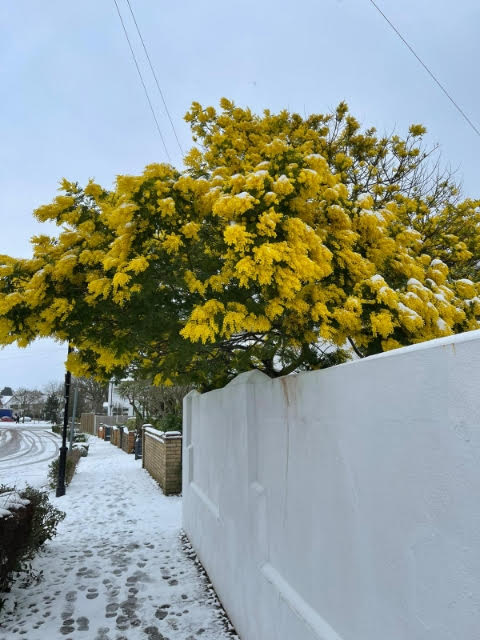
The best time to clip them is in April, after they have finished flowering. As you can see, this photo was taken by the client in February of this year, as the snow and ice had settled on the street.
Although the flower is a harsh yellow, almost like the ever-popular (why?) Forsythia, it has a much softer leaf than that shrub, so I prefer Robinia as a specimen in the garden.
I’m not sure it works in a country garden (why not prove me wrong and give it a go?) but in a modern landscape, or city context, or here by the sea, I think it looks a burst of joy for early in the year.
Robinia As Topiary
Often I see Robinia used as a standard ‘lollipop’ topiary, a bare, straight stem with a blob at the top about 6 or 8 feet high. This looks fine (and is of course useful for screening above a fence) but in my head I see Robinia the way I look at an Acer…. as a small tree or large shrub that needs to slowly grow up… and out… and fall back down.
As if giving a gentle shrug to the horizon.
So when deciding on a topiary, look at the inherent nature of the plant and use its strength. Drawing out what it does best is a simple recipe for success.
There are more photos of some topiary I clipped recently that ended up under snow and ice here.
Or if you need help with your topiary (Robinia or otherwise) check what else I do on the topiary page.
Modern Topiary, the Book, at Garden Media Guild
My book about topiary, Modern Topiary, has been mentioned on the Garden Media Guild newsletter…. As the screenshot says, the book can be read for free online here. At the bottom of the screenshot, it looks like another Garden Media Guild member has a book out called ‘A Year In A Cottage Garden’…. so if that is where your garden heart lies, check that out too! And at the top of the screenshot, it looks like I was listening to Pelleas et Melisande, by Debussy. What a classy chap I am, listening to classical music as I reply to emails. …
Start of the Whitby Topiary Library
I have been offered a space here in the centre of Whitby, south-facing aspect, with some raised beds in, so that I can make a Topiary Library. In my head, a topiary library is a place to showcase the common (and then not so common) shapes you can make out of topiary. With classical topiary plants, as well as some more unusual pieces. This Topiary Library can act as a reference for people to learn more about pruning and clipping. The space is small but the aspect is great and the beds are deep enough to put some plants in. …
Delivery After Dark – From the Makers of The Amelia Project
Last week I spent most nights stood in cold water streams on the moors of North Yorkshire, helping to film a new project called Delivery After Dark from the makers of the Amelia Project. I worked on the Amelia Project back at the end of 2024, lending my terrible vocal talents to a small part in the episode Didius Julianus. But this project is something new – and exciting! – and thankfully only needed me to be filmed, rather than to actually say anything. But not only did I have to stand in cold moving water at midnight, I also …