
THE MODERN MINT BLOG
How To Sharpen Shears
We often get asked – how do I sharpen my shears?
Update – a video tutorial on how to sharpen your shears!
In this blog, we will give you simple to follow instructions on exactly how to do it. But first, you have to have the right shears and the right equipment….
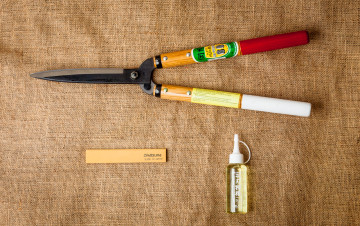
Our hedge shears of choice are these red and white handled ones from Japan.
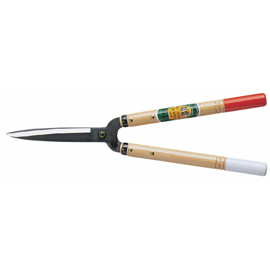
They look the bees knees. And they are.
The steel is incredible, meaning it is sharp enough to cut the vegetation you want cut down. Because the steel is so good, you can also sharpen it back to factory sharpness.
Cheap steel, once blunted, stays blunt. A waste of money.
It took about ten years of gardening before I took the plunge and spent my money on these. Now, of course, I can’t go back to using anything else (and have now used them for over a decade!) Working for a landscaper back in early March of this year, I picked up another pair of shears from a colleague as they happened to be next to me at the time. I began to use them to cut down a Miscanthus and they felt awful….!
Every cut was a fight with the plant, stems got bruised instead of clipped, the tool felt like they would break and my wrists and arms had to work hard to make anything happen.
It would have taken less energy to walk back to the van and pick up my own Japanese shears (that will teach me for being lazy…)
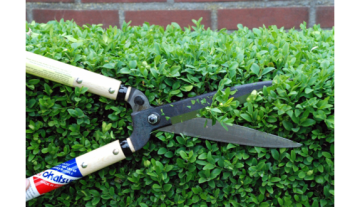
The balance and weight of these shears is amazing – but if you’re wondering if they are too heavy, it really is useful to pop into Niwaki (who sell them) or find a keen gardener who has a pair and give them a try.
The amazing lightness and balance of these shears make them ideal for anyone – male or female, right or left-handed – and because they cut so cleanly they make lighter work of your topiary or mixed hedges.
How To Sharpen Your Shears
Finally, we get to the important bit. How to sharpen them. First of all, get a whetstone – we prefer the traditional Japanese whetstone as it doesn’t tear the steel of the blades. You can use a diamond sharpener, but it is likely to tear the steel… the better the steel, the more need for you to be so so gentle….
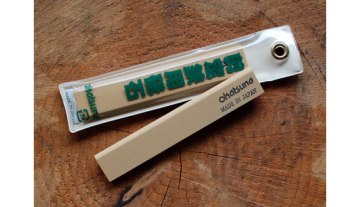
1) Make sure the whetstone is wet. At least 30 seconds in water or under a tap should soak it. One sign is the water stops bubbling!
2) Move any part of the stone gently across the edge of the blade – whether shears or secateurs. I use a small, circular motion. Others use a forward and back motion, so the stone comes towards your body and then away from your body.
3) Move along the blade. If you feel the stone drying, dip it into water or under a tap again.
4) If you do this for a couple of minutes you will see a line of fresh steel along the blade. The more you do it, the better your eye will be at discerning when the blade is sharp. It does take a little practise, and also time… but the results are always better!
5) Turn the blade over – there will be a burr on its backside. Run the whetstone along this side of the blade once or twice, from bottom to top, to remove the burr (and any sap or stone that is left on this side of the blade.)
6) A little squeeze of oil onto the blades, then wipe it clean with a cloth, will keep the steel your tools in great condition.

The oil should last a long time as you don’t need much of it. (Though I now use it on other tools as well, so do get through it a bit quicker!)
Again, the above photo is the traditional oil used in Japan, made from camellia, but any oil will do (including olive! But not WD-40!)
I just happen to like tradition so use the camellia oil.
There you go – a short tutorial on how to sharpen your shears. And there is a new video here on sharpening, as you may find it easier to watch what to do.
Any questions please do contact me, otherwise enjoy your shears and the clipping you will do!
Happy topiary-making!
Modern Topiary, the Book, at Garden Media Guild
My book about topiary, Modern Topiary, has been mentioned on the Garden Media Guild newsletter…. As the screenshot says, the book can be read for free online here. At the bottom of the screenshot, it looks like another Garden Media Guild member has a book out called ‘A Year In A Cottage Garden’…. so if that is where your garden heart lies, check that out too! And at the top of the screenshot, it looks like I was listening to Pelleas et Melisande, by Debussy. What a classy chap I am, listening to classical music as I reply to emails. …
Start of the Whitby Topiary Library
I have been offered a space here in the centre of Whitby, south-facing aspect, with some raised beds in, so that I can make a Topiary Library. In my head, a topiary library is a place to showcase the common (and then not so common) shapes you can make out of topiary. With classical topiary plants, as well as some more unusual pieces. This Topiary Library can act as a reference for people to learn more about pruning and clipping. The space is small but the aspect is great and the beds are deep enough to put some plants in. …
Delivery After Dark – From the Makers of The Amelia Project
Last week I spent most nights stood in cold water streams on the moors of North Yorkshire, helping to film a new project called Delivery After Dark from the makers of the Amelia Project. I worked on the Amelia Project back at the end of 2024, lending my terrible vocal talents to a small part in the episode Didius Julianus. But this project is something new – and exciting! – and thankfully only needed me to be filmed, rather than to actually say anything. But not only did I have to stand in cold moving water at midnight, I also …