
THE MODERN MINT BLOG
Phillyrea is a shrub I came across a fair few years ago, in my search for clippable topiary shrubs for my own topiary work.
It seems to have been out of favour a long time – this piece about the plant by Mary Keen is from 2004, encouraging gardeners to try it out. But those 13 years pale in comparison to the last time it was popular – in the 17th and 18th centuries!
This Blog About Phillyrea Teaches You…
- Why it might be unpopular now
- Shows photos of it as beautiful topiary, as well as a mature plant
- Suggests the tool you need to prune it
- Takes advice from Architectural Plants on how to grow it
- Considers its role as a valuable plant for bees
Why Is Phillyrea Unpopular Now?
This is a tough one to answer, especially when you see how lovely the plant is…

It is a member of the olive family

Looks amazing clipped into topiary!
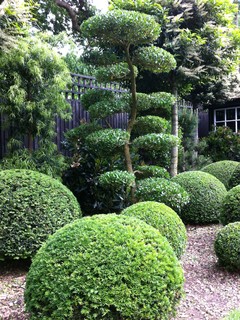
Cloud Pruning!
The fact it isn’t used more may have something to do with cost and availability. Most places who say they stock it will not have any available, while prices seem to vary greatly – a pre-clipped, cloud-pruned shrub will cost a lot more as you are paying for the topiarists time making it into that shape, while a normal 2 litre pot will be in the £8-10 range.
We heard from a nurseryman it is incredibly difficult to propagate, which is backed up by the Mary Keen piece on this lovely shrub.
We do not agree with her on one thing she says though…
“It seems a pity to clip the larger leafed form (latifolia) – if you must, tackle it with secateurs as you would laurel, so that the leaves are never sliced in half; this makes evergreens look dreadful. P. angustifolia can be clipped in the same way as box or holm oak.”
Nope! Shears will do just fine on this tree! Well, good shears….

Like a large head of broccoli.
How To Grow Phillyrea
Here is what Architectural Plants (where you are most likely to get a pre-cloud pruned plant) have to say about it:
“Tough as old boots. It’ll grow in sun or shade and on any soil but to get the best out of these trees they need space and light. You could say, the more exposed, the better.
It clips beautifully.
It’s only peccadillo is a terrible weakness for white fly. They’re inconvenient but there’s little you can do so ignore them.
We often sell these when restoring Tudor, Elizabethan or Mediaeval gardens. There’s masses of evidence to show that Phillyrea was used extensively hundreds of years ago. The diarist John Evelyn writes of them frequently – as if they were then as common as box, yew and holly.
What happened? They used to be so widespread and now they’re rare.
Garden historians are perplexed and so are we.”
Fantastic piece from a lovely nursery.
And check out this blog about Phillyrea from 400 years ago!
Phillyrea – Good For Bees?
Apparently, yes.
John Worlidge (who smartly advocated we make cider, not wine here in the UK, because that suited our climate better… oh how times have changed with English wine becoming the thing!) wrote in 1676:
“above any tree, the bees most affect the phillyrea; one sort of them beareth in those months (spring) an abundance of greenish blossoms, which yield great plenty of of gummy rosinny sweat, which the bees daily transport to their hives…. nothing can be more acceptable to your bees than a hedge of this tree about your apiary.”
If you can get Phillyrea cheap enough as a hedging plant, would this be worth a go?
We think so!
Finishing Up On Phillyrea…
This really is a useful plant – easy to grow, easy to keep in shape if you have a small garden, allows you to have fun with pruning tools when you give it the topiary treatment, reflects light from its leaves to brighten up the garden and can be a boon for bees.
We have planted it for one client, but will be making sure Phillyrea is down on the list of any plant schedule in the future.
And you should try growing Phillyrea too!
Further Reading: Phillyrea from nearly 400 years ago.
If you need help with any topiary or pruning in your garden, Phillyrea or otherwise, do contact me.
Start of the Whitby Topiary Library
I have been offered a space here in the centre of Whitby, south-facing aspect, with some raised beds in, so that I can make a Topiary Library. In my head, a topiary library is a place to showcase the common (and then not so common) shapes you can make out of topiary. With classical topiary plants, as well as some more unusual pieces. This Topiary Library can act as a reference for people to learn more about pruning and clipping. The space is small but the aspect is great and the beds are deep enough to put some plants in. …
Delivery After Dark – From the Makers of The Amelia Project
Last week I spent most nights stood in cold water streams on the moors of North Yorkshire, helping to film a new project called Delivery After Dark from the makers of the Amelia Project. I worked on the Amelia Project back at the end of 2024, lending my terrible vocal talents to a small part in the episode Didius Julianus. But this project is something new – and exciting! – and thankfully only needed me to be filmed, rather than to actually say anything. But not only did I have to stand in cold moving water at midnight, I also …
Modern Topiary (The Book) – Message From Lady Clippers, And Others!
My topiary book – Modern Topiary – has recently been put out as a PDF, which can be read for free. (Have a look here to download and read/share it!) Then last week I received a lovely email from Ann Perkowski of Lady Clippers, who are topiary and pruning specialists in New York (Ann is a brilliant pruning teacher too, who teaches at New York Botanical Garden… check out her work and Lady Clippers website.) Hi Darren, I had to write you how much I love reading your Modern Topiary. I’m not sure I’ll ever be quite done with it because I’m …