
THE MODERN MINT BLOG
A new year, so time to share a few thoughts on what I will be looking at doing with topiary, and the focus on teaching I would like to put in place, for 2026 and beyond.
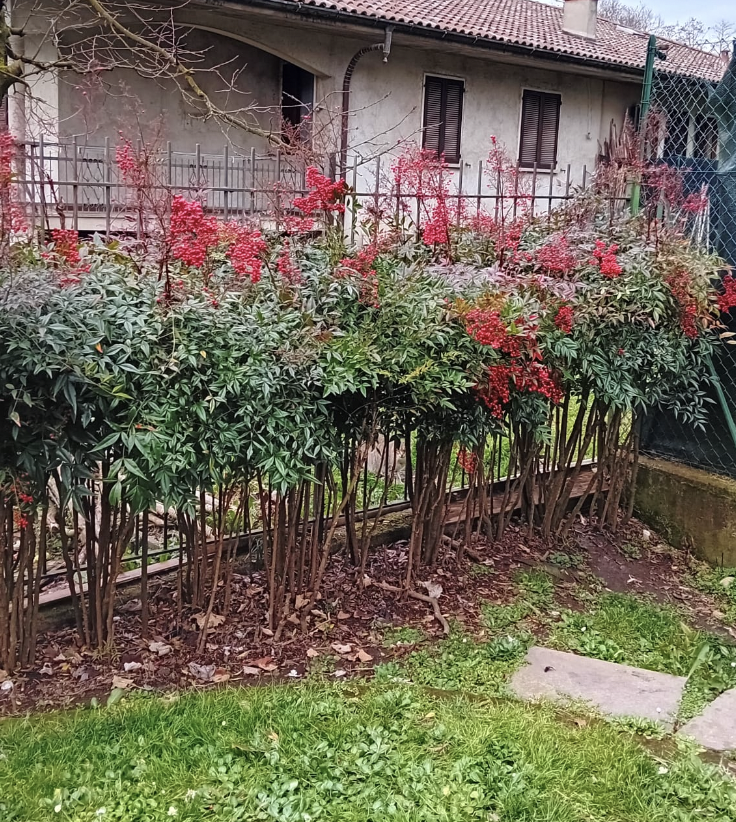
Above is Nandina, made by a student of ours from the European Boxwood and Topiary Society. She took a year to work on this, taking a plant not renowned for being a good topiary plant, but seeing what its weirdness is and what values it does have, then exploring and exploding those.
I am thrilled by this. Not just this look for autumn. A shiny-leafed, red and green Christmassy feel in darker days. But more so the values I want from students being embodied by the student in order to make this:
Committing to work with what you’ve got. In this case, a non-traditional topiary plant in Nandina.
Looking at what the Nandina offers – the straight stems, that are then shown off. The lanced, shiny leaf. The contrast this creates with the fluffly white flowers which then become these reflective red berries. The best parts of the plant, shown off by thoughtful pruning.
The thought process behind the design. How to use contrast to create a shape that works.
This is what I love about teaching. There is only so much you can do with a student. The work is to give everybody who is there the foundation skills they need to make and think about topiary. But when a student is keen, is driven, then opening the door for them to burst through is such a pleasure to watch. Which is exactly what has happened with this student. Our role at the EBTS was just to encourage effort, to keep nudging her to stay committed to the process. Whether it worked out at the end, well, we can never be completely sure. But this did. And being Nandina, it happened quickly. One of the benefits of using non-traditional topiary plants is that they might be quicker growing, which makes up for their lack of ‘classiness’ and ability to be reinvented over time. Decades often, in the case of plants like Taxus and Buxus.
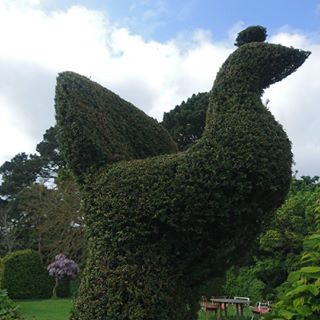
The above is a topiary in the garden of my mentor, my teacher, theQueen of Topiary Charlotte Molesworth.
What she did for me is the following:
She gave me the base skills I needed to be able to clip well.
She gave me the opportunity to clip. To prune and to maintain and to make as many topiaries as possible.
A high standard to clip to, to achieve, to drive towards.
Looking back, this was the simplest and best thing that could have come my way. It changed my life. I was gardening and interested in topiary, trying my hardest to find pieces to work on and convince clients to follow the vision I had. Although without the portfolio and experience to make it happen… with confidence. But from meeting Charlotte Molesworth and getting to work in her garden and help on her work I then had the opportunity to specialise. To learn fast. And it was tough. I had to put myself out there, commit, get things wrong, learn by doing…
But I was given the opportunity.
Opportunity is everything. Artists in the ‘olden days’ and I’ll let you decide what that means, because I’m not really sure of dates and I don’t much care to spend time researching it, because the point isn’t about historical accuracy, the point is about – painters would work with a master. To learn and experience everything that was going on. Being there with someone was a way of learning craft.
And that is what I want to setup for people. Opportunity.
So much of what we read and hear, so many of our cultural vitamins, are from the likes of Donald Trump and Nigel Farage. Men who commit to nothing but their own gain, their own ability to snake around any real values and just loot as much as they can from those with less. This is dull, boring, pathetic. These are not the cultural vitamins I want to be given each day. That I want to be taking in.
The future of Modern Mint, and my work, is going to be less maintenance, and more making and renovating of topiary.
Then teaching other people how to maintain and improve what has been made.
This means I can share the important skills that I have been given – the chance to learn my craft, to pay attention to quality over speed, to work efficiently (which then gives you speed!), to connect with people and to lean into and earn a lvoe for the pysical work and the act of creation.
Exciting times for 2026 and ahead. I have no idea how to make this happen just yet. But this is where I am headed. Hurray for the new year, and topiary teaching for 2026!
Italian Translation of Modern Topiary, The Book
This is something special! Bianca Pastori, who is a keen topiarist in Italy, has produced an Italian translation of my book Modern Topiary. Some of her topiary work can be viewed in a blog post here about teaching topiary in 2026. So if you want an Italian version of Modern Topiary the book, please do download and read the free PDF below. (Yes, I do know the download button is tiny. I still haven’t worked out how to make it bigger, better and easier to click on. Doh!) For the version of Modern Topiary in the original language – English …
Modern Topiary, the Book, at Garden Media Guild
My book about topiary, Modern Topiary, has been mentioned on the Garden Media Guild newsletter…. As the screenshot says, the book can be read for free online here. At the bottom of the screenshot, it looks like another Garden Media Guild member has a book out called ‘A Year In A Cottage Garden’…. so if that is where your garden heart lies, check that out too! And at the top of the screenshot, it looks like I was listening to Pelleas et Melisande, by Debussy. What a classy chap I am, listening to classical music as I reply to emails. …
Start of the Whitby Topiary Library
I have been offered a space here in the centre of Whitby, south-facing aspect, with some raised beds in, so that I can make a Topiary Library. In my head, a topiary library is a place to showcase the common (and then not so common) shapes you can make out of topiary. With classical topiary plants, as well as some more unusual pieces. This Topiary Library can act as a reference for people to learn more about pruning and clipping. The space is small but the aspect is great and the beds are deep enough to put some plants in. …