
THE MODERN MINT BLOG
Topiary Library
I do a lot of teaching topiary. I had the opportunity from my mentor, Charlotte Molesworth, to work on her garden and experiment and test techniques and generally try making shapes without the worry of failure, or being fired, or being sued and run out of business for getting it wrong.
This opportunity was essential (along with Charlotte’s insistance that pruning standards had to be high!) in becoming better at topiary.
When I look around the world at our cultural vitamins, what we see in the media day in and day out, I see the stupidest and grossest of people (men, mostly) shouting loudly and looking smug, and pressing the belief on people that life is a zero-sum game, and they must take it all in order to win… and for you to get some of it, fall into line.
This seems anathema to what I think about life, and it makes me feel sick.
So?
I want to fight this (lack of) cultural vitamins we are bombarded with every day, by offering opportunity to people who could do with it. Unlock the door and, if someone is keen, they will head through it. My turn to offer opportunity, the way Charlotte Molesworth did for me all those years ago.
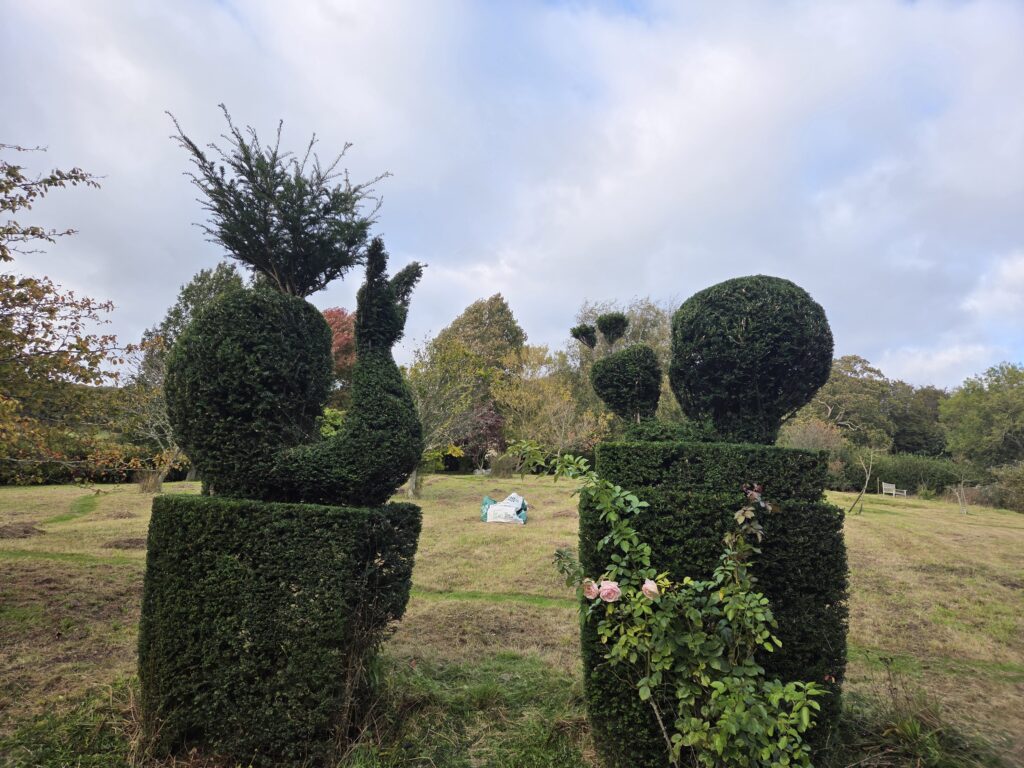
So I wish to start a Topiary Library – a piece of land with topiaries on, from basic shapes of balls and cones, duos and spirals, to traditional figurative pieces like birds and dogs, to the aesthetic pruning style seen in California to the wacky, extreme shapes that grow organically from the chaos that working with a living thing can demand you create.
This piece of land needn’t be too big – 10 square metres is sufficient – or, what? 40 topiaries? That should be enough.
They don’t need to be traditional plants either – boxwood and yew are fantastic, but oak, hawthorn, pyracantha, birch – these will all work too.
Because this is a place for people to have the opportunity to clip. To experiment. To learn by having to commit to pruning, then making choices about what to cut and where, and then doing it.
I envisage the Topiary Library (a Library becasue it is a reference garden for topiary shapes, plants and pruning styles!) to work like this:
- Plant cheap hedging plants in the Autumn.
- Water and mulch around the plants. Provided by the landowner.
- Leave the topiary plants to settle through winter. No more water necessary, the plants will have to make do through winter and summer!
- April/May begin to clip with a student who has taken a beginners course, or who is ready to take this opportunity. Mulch again.
- September/October clip and mulch again as necessary with the student.
Allow the plants to gain density of leaf and branch, to improve their shapes. Take photos and share on the European Boxwood & Topiary Society website, my website (if I have time to write a blog and share it!) and at talks and in teaching to showcase what can be achieved with these plants when used as green architecture in the garden.
In addition, this Topiary Library could be used by those keen on soil science to study carbon capture, or those who wish to note wildlife and the affect topiary has – beneficial? I think so! But would love the data to back this up! – on benefiting birds, bees and other wildlife.
The end of this project would probably be 5 years down the line, to dig the plants up and sell them. Or to leave them in place, for others to use, clip and enjoy.
I have some money set aside to buy some plants, some time free in my diary to offer teaching. But what I don’t have is the land, the space, in which to make the Topiary Library. Nor do I want to invest in land – I want to invest in people, to give them the resources to learn, to go through the door!
So if you have a piece of land, some space, or some topiaries or an old hedge or even some shrubs that could do with being pruned, and you don’t mind what they might become, and are happy for a student to work on them, to be a part of gifting an opportunity to a keen topiary maker, then… contact me and we can discuss how to work together on this project.
It would be wonderful to have a number of satellite ‘Topiary Libraries’ around the the UK (or abroad?) that would circumvent the need to spend money on land, and instead allow resources to be given to people.
To fight the gross cultural vitamins we see everyday and offer opportunity, skills, and a sense of fun in creativity that topiary can give a pruner.
Hope to speak to you soon about the opportunity for a Topiary Library.
UPDATE – The Whitby Topiary Library is being planted this week!
Start of the Whitby Topiary Library
I have been offered a space here in the centre of Whitby, south-facing aspect, with some raised beds in, so that I can make a Topiary Library. In my head, a topiary library is a place to showcase the common (and then not so common) shapes you can make out of topiary. With classical topiary plants, as well as some more unusual pieces. This Topiary Library can act as a reference for people to learn more about pruning and clipping. The space is small but the aspect is great and the beds are deep enough to put some plants in. …
Delivery After Dark – From the Makers of The Amelia Project
Last week I spent most nights stood in cold water streams on the moors of North Yorkshire, helping to film a new project called Delivery After Dark from the makers of the Amelia Project. I worked on the Amelia Project back at the end of 2024, lending my terrible vocal talents to a small part in the episode Didius Julianus. But this project is something new – and exciting! – and thankfully only needed me to be filmed, rather than to actually say anything. But not only did I have to stand in cold moving water at midnight, I also …
Modern Topiary (The Book) – Message From Lady Clippers, And Others!
My topiary book – Modern Topiary – has recently been put out as a PDF, which can be read for free. (Have a look here to download and read/share it!) Then last week I received a lovely email from Ann Perkowski of Lady Clippers, who are topiary and pruning specialists in New York (Ann is a brilliant pruning teacher too, who teaches at New York Botanical Garden… check out her work and Lady Clippers website.) Hi Darren, I had to write you how much I love reading your Modern Topiary. I’m not sure I’ll ever be quite done with it because I’m …